:::::::::::::::::::::::::::::::::::::::::::::::::::::::::::::::::::::::::::::::::::::::::::::::::::::
Mandarin Ducks, 鴛鴦 symbol for a happy couple
Pillows with mandarin duck desing make great wedding gifts in China, so do curtains and bedcovers.
When one duck carries a lotus flower and the other animal a lotus fruit, this expresses the wish for a marriage blessed with many sons.
"Mandarin ducks in the dew" is a Chinese expression for unmarried lovers, though.
Even in the world of the Chines sexual intercourse instructions, there is the position "Mandarin Duck Union".
Below are two pieces from my home (after 30 years of happy marriage).
..... .....
Meoto Daruma and Takasago - Daruma and a Happy Couple
夫婦だるまと高砂
Fuufu Daruma, Enmusubi Daruma 夫婦だるま、縁結びだるま
:::::::::::::::::::::::::::::::::::::::::::::::::::::::::::::::::::::::::::::::::::::::::::::::::::::
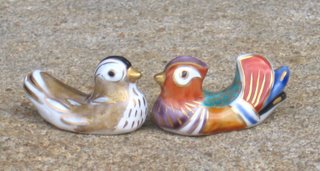
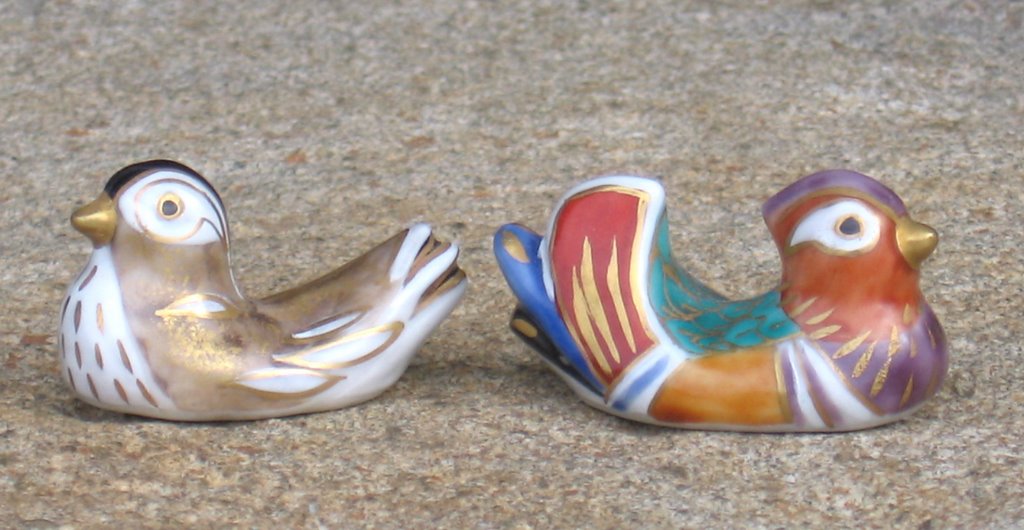
Chopstick rests (hashi oki 箸置き)

a silent pair
on the dinner table -
mandarin ducks
:::::::::::::::::::::::::::::::::::::::::::::::::::::::::::::::::::::::::::::::::::::::::::::::::::::
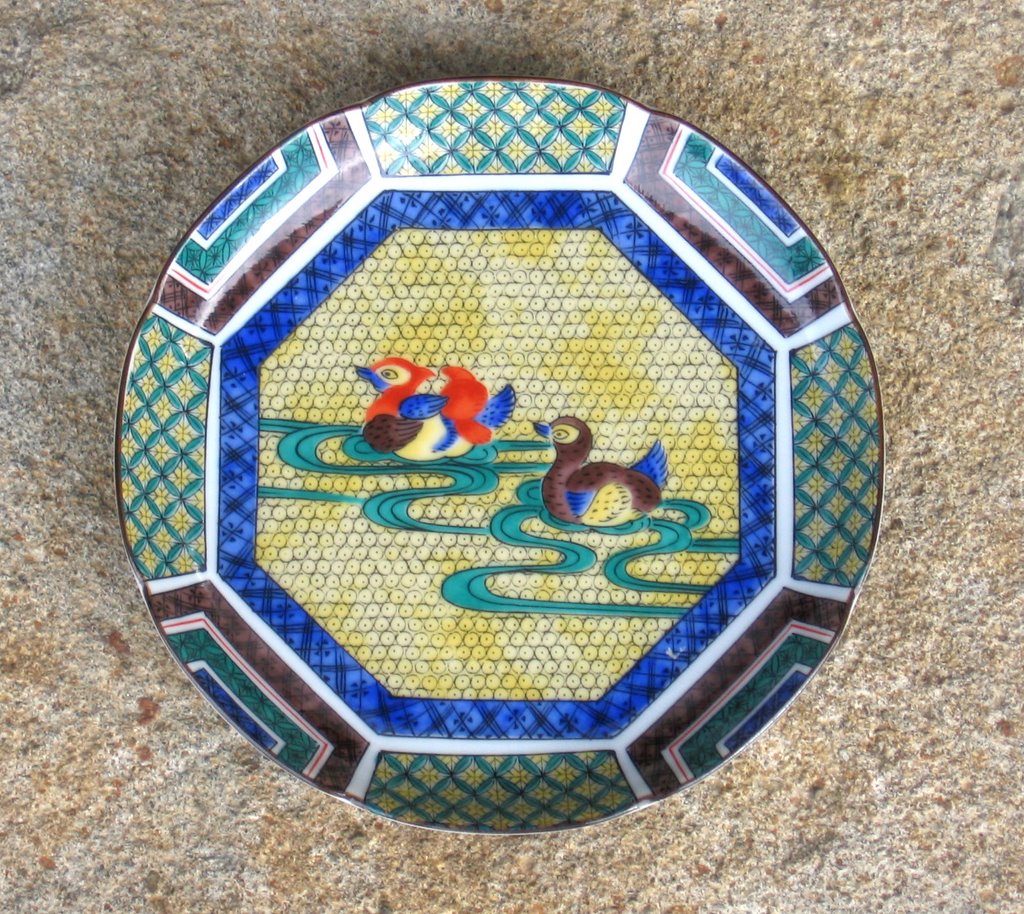
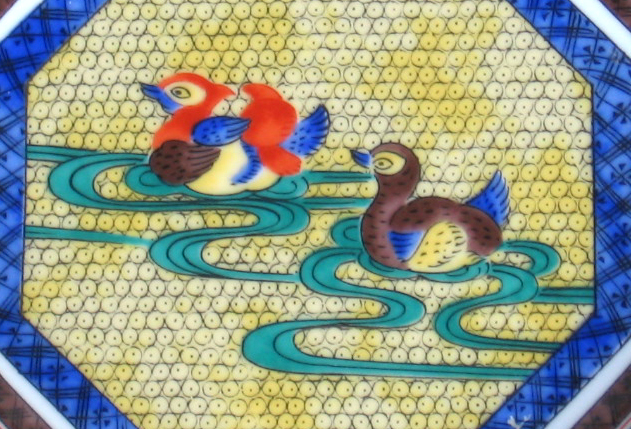
This is a plate from Kutani Pottery
:::::::::::::::::::::::::::::::::::::::::::::::::::::::::::::::::::::::::::::::::::::::::::::::::::::
Mandarin Duck (Aix galericulata)
Mandarin Ducks, which are referred to by the Chinese as Yin-Yang ducks 陰陽 , are frequently featured in Oriental art and are regarded as a symbol of conjugal affection and fidelity. A Chinese proverb for loving couples uses the Mandarin Duck as a metaphor:
"Two swimming mandarin ducks".
The Mandarin Duck symbol is also used in Chinese weddings, because in traditional Chinese lore they symbolize wedded bliss and fidelity. In reality, though, the ducks find new partners each year.
Read more in the WIKIPEDIA !
:::::::::::::::::::::::::::::::::::::::::::::::::::::::::::::::::::::::::::::::::::::::::::::::::::::
Mandarin Ducks: Three Arita Figurines
Mandarin Ducks: Arita Plate
- further Bird Figurines, including our Ducks -
:::::::::::::::::::::::::::::::::::::::::::::::::::::::::::::::::::::::::::::::::::::::::::::::::::::
. WKD : Why Ducks Sleep Standing On One Leg
A legend from Vietnam.
:::::::::::::::::::::::::::::::::::::::::::::::::::::::::::::::::::::::::::::::::::::::::::::::::::::
- quote
OSHIDORI: By Lafcadio Hearn
There was a falconer and hunter, named Sonjo,
who lived in the district called Tamura-no-Go, of the province of Mutsu. One day he went out hunting, and could not find any game. But on his way home, at a place called Akanuma, he spotted a pair of oshidori (mandarin ducks), swimming together in a river that he was about to cross. To kill oshidori is not good; but Sonjo happened to be very hungry, and he shot at the pair. His arrow pierced the male: the female escaped into the rushes of the further shore, and disappeared. Sonjo took the dead bird home, and cooked it.
That night he dreamed a dismal dream. It seemed to him that a beautiful woman came into his room, stood by his pillow, and began to weep. So bitterly she wept that Sonjo felt as if his heart were being torn out as he listened.

The woman cried to him,
"Why…oh! Why did you kill him? Of what wrong was he guilty? At Akanuma we were so happy together…and you killed him! What harm did he ever do you? Do you even know what you have done? Oh! Do you know what a cruel, what a wicked thing you have done? Me too you have killed, for I will not live without my husband! Only to tell you this I came."
Then again she wept aloud, so bitterly that the voice of her crying pierced into the marrow of the listener's bones. And she sobbed out the words of this poem:
Hi kurureba Sasoeshi mono o Akanuma no
Makomo no kure no Hitori-ne zo uki!
At the coming of twilight
I invited him to return with me!
Now to sleep alone
In the shadow of the rushes of Akanuma –
Ah! What misery unspeakable!
After having spoken these verses she exclaimed,
"Ah, you do not know! You cannot know what you have done! But tomorrow, when you go to Akanuma, you will see, you will see..."
So saying, and weeping very heartbreakingly, she went away.
When Sonjo awoke in the morning, the dream remained so vivid in his mind that he was greatly troubled. He remembered the words: "But tomorrow, when you go to Akanuma, you will see. You will see!" And he decided to go there immediately, so that he could learn whether his dream was anything more than a dream.
He went to Akanuma; and there, when he came to the riverbank, he saw the female oshidori swimming alone. In the same moment, the bird saw Sonjo, but instead of trying to escape, she swam straight towards him, looking at him all the while in a strange fixed way. Then, with her beak, she suddenly tore open her own body, and died before the hunter's eyes.
Sonjo shaved his head, and became a priest.
source : takayamarooftop.blogspot.jp
:::::::::::::::::::::::::::::::::::::::::::::::::::::::::::::::::::::::::::::::::::::::::::::::::::::
In Haiku, ducks (kamo) are a kigo in various seasons .
Mandarin Ducks, oshidori 鴛鴦、おしどり
kigo for winter
Because of their symbolism, they are well used in haiku and other forms of Japanese poetry. A happy couple is called "mandarin duck couple", oshidori fuufu おしどり夫婦.
Other names (wings means birds) are
"thoughtful wings", omoiba 思羽
"gingko tree wings", ichooba 銀杏羽
"sword wings", tsurugiba 剣羽
husband/wife, oshi no tsuma 鴛鴦の妻
feather coat of a mandarin duck
..... 鴛鴦の毛衣 おしのけごろも
mandarin duck sleeping on the water
..... oshi no ukine 鴛鴦の浮寝 おしのうきね
mandarin duck sleeping alone
..... oshi no hitorine 鴛鴦の独寝 おしのひとりね
Click HERE to see some Japanese "OSHIDORI" !
Couple’s Day (fuufu no hi, Japan) kigo for February 2

mallard ducks 真鴨 magamo
Hasui Kawase (1883-1957)
Mandarin Ducks : DUCK KIGO in other seasons
BIRD SAIJIKI
ooo ooo ooo ooo ooo ooo ooo ooo ooo ooo ooo
furu ike no oshidori ni yuki furu yuube kana
at the old pond
snow falls on mandarin ducks
in twilight
Matsuo Basho
(Tr. Michael Haldane )
:::::::::::::::::::::::::::::::::::::::::::::::::::::::::::::::::::::::::::::::::::::::::::::::::::::
- - - - - Yosa Buson - - - - -
鴛に 美をつくしてや 冬木立
oshidori ni bi o tsukushite ya fuyu kodachi
Here is perfect beauty
mandarin ducks
under winter trees
Tr. Merwin/Lento
using up its beauty
on mandarin ducks,
the winter grove
Tr. Ueda
furuike no oshidori ni yuki furu yuube kana
at the old pond
snow falls on mandarin ducks
in twilight
Tr. Haldane
oshidori ya ike ni otonaki kashi no ame
(1769)
Mandarin ducks--
Falling soundless on a pond
Rain through oaks.
Tr. Nelson/Saito
をし鳥や 鼬の覗く 池古し
oshidori ya itachi no nozoku ike furushi
A mandarin pair!
But the pond is old,
and its weasel is watching there.
Henderson
鴛(をしどり)や獺(をそ)の飛込む水古し
oshidori ya oso no tobikomu mizu furushi
mandarin ducks -
an otter jumps into
the old water
. WKD : Yosa Buson 与謝蕪村 in Edo .
:::::::::::::::::::::::::::::::::::::::::::::::::::::::::::::::::::::::::::::::::::::::::::::::::::::

source : toshidama.wordpress.com
Mandarin Ducks (Oshidori) Swimming Among Water Grasses
Utagawa Hiroshige (1797-1858)

Hirosada, Uto Yasukata, an actor as a hornbilled puffin
- source : toshidama.wordpress.com -
The Ghost of Uto Yasukata
善知鳥安方忠義伝
... the kabuki drama Uto Yasakuta Chugiden (The Loyalty of the Horn-billed Puffin) tells a scene from the story of Princess Takiyasha, daughter of the deposed despot Masakado, who takes revenge against the families of her father’s assassins. One of these, Mitsukuni, is set upon by the princess and sorceress in a great fight amid the ruins of Masakado’s palace. ...
- source : toshidama-japanese-prints.com/ Kunichika -
. Join the Ukiyo-E friends on facebook ! .

:::::::::::::::::::::::::::::::::::::::::::::::::::::::::::::::::::::::::::::::::::::::::::::::::::::
- - - - - Masaoka Shiki - - - - -
古池や昼静かなる夏の鴛
furuike ya hiru shizuka naru natsu no oshi
this old pond -
in summer at noon they become quiet
the mandarin ducks
古池のをしに雪降る夕かな
furuike no oshi ni yuki furu yuube kana
snow falls on the mandarin ducks
in the old pond -
this evening
古池に亡き妻や思ふ鴛一羽
furuike ni naki tsuma omou oshi ichiwa
in the old pond
one mandarin duck
thinks of its dead wife
芙蓉咲いて古池の鴛やもめ也
fuyo saite furuike no oshi yamome nari
cotton roses flowering -
the mandarin duck in the old pond
is a widower
. Masaoka Shiki 正岡子規 and Old Pond haiku .
:::::::::::::::::::::::::::::::::::::::::::::::::::::::::::::::::::::::::::::::::::::::::::::::::::::
Mongolia
Mongolians call the mandarin duck as "lama bird" and respect it. Mongolian monk's costume is orange color, like mandarin duck.
broken egg...
a lama bird's cry hangs
in the air
Zaya Nergui
. WKD :
MONGOLIA SAIJIKI .
:::::::::::::::::::::::::::::::::::::::::::::::::::::::::::::::::::::::::::::::::::::::::::::::::::::
In winter light
two swimming mandarin ducks -
they move as one...
© Dana-Maria Onica, Romania
:::::::::::::::::::::::::::::::::::::::::::::::::::::::::::::::::::::::::::::::::::::::::::::::::::::
Aylesbury duck
The Aylesbury duck is a breed of domesticated duck, bred mainly for its meat and appearance. It is a large duck with pure white plumage, a pink bill, orange legs and feet, an unusually large keel, and a horizontal stance with its body parallel to the ground. The precise origins of the breed are unclear, but raising white ducks became popular in Aylesbury, Buckinghamshire, England in the 18th century owing to the demand for white feathers as a filler for quilts. Over the 19th century selective breeding for size, shape and colour led to the Aylesbury duck.
Duck rearing became a major industry in Aylesbury in the 19th century. The ducks were bred on farms in the surrounding countryside. Fertilised eggs were brought into the town's "Duck End", where local residents would rear the ducklings in their homes. The opening of a railway to Aylesbury in 1839 enabled cheap and quick transport to the markets of London, and duck rearing became highly profitable. By the 1860s the duck rearing industry began to move out of Aylesbury into the surrounding towns and villages, and the industry in Aylesbury itself began to decline.

In 1873 the Pekin duck was introduced to the United Kingdom. Although thought to have a poorer flavour than the Aylesbury duck, the Pekin was hardier and cheaper to raise. Many breeders switched to the Pekin duck or to Aylesbury-Pekin crosses. By the beginning of the 20th century competition from the Pekin duck, inbreeding and disease in the pure-bred Aylesbury strain and the rising cost of duck food meant the Aylesbury duck industry was in decline.
The First World War badly damaged the remaining duck industry in Buckinghamshire, wiping out the small scale producers and leaving only a few large farms. Disruption caused by the Second World War further damaged the industry. By the 1950s only one significant flock of Aylesbury ducks remained in Buckinghamshire, and by 1966 there were no duck breeding or rearing businesses of any size remaining in Aylesbury itself. Although there is only one surviving flock of pure Aylesbury ducks in the United Kingdom and the breed is critically endangered in the United States, the Aylesbury duck remains a symbol of the town of Aylesbury, and appears on the coat of arms of Aylesbury and on the club badge of Aylesbury United.
© More in the WIKIPEDIA !
an Aylesbury duck
paddling through my mind --
the heat!
- Shared by Karen Cesar -
Joys of Japan, 2012
:::::::::::::::::::::::::::::::::::::::::::::::::::::::::::::::::::::::::::::::::::::::::::::::::::::
- The BIRD SAIJIKI -
[ . BACK to WORLDKIGO . TOP . ]
[ . BACK to DARUMA MUSEUM TOP . ]
:::::::::::::::::::::::::::::::::::::::::::::::::::::::::::::::::::::::::::::::::::::::::::::::::::::







 Posts
Posts