Showing posts with label painting. Show all posts

5/04/2012

Dragon wallpaper

[ . BACK to DARUMA Museum TOP . ]
:::::::::::::::::::::::::::::::::::::::::::::::::::::::::::::::::::::::::::::::::::::::::::::::::::::

Wallpaper for your computer


http://windows.microsoft.com/ja-jp/windows/downloads/personalize/wallpaper-desktop-background


::::::::::::::::::::::::::::::::::::::::::::::::::::::::::::::::::::::::::::::::::::::::::::::::::::: 

. WKD : BIG FONT LINK .


[ . BACK to WORLDKIGO . TOP . ]
[ . BACK to DARUMA MUSEUM TOP . ]
:::::::::::::::::::::::::::::::::::::::::::::::::::::::::::::::::::::::::::::::::::::::::::::::::::::

3/06/2012

Nine Dragons Painting Chen Rong

[ . BACK to DARUMA Museum TOP . ]
:::::::::::::::::::::::::::::::::::::::::::::::::::::::::::::::::::::::::::::::::::::::::::::::::::::

Nine Dragons 九龍圖卷


Artist: Chen Rong 陳容 (active first half of the 13th century),
Chinese: Southern Song dynasty
Date: dated 1244
Materials: Ink and touches of red on paper
Dimensions: 46.3 x 1096.4 cm (18 14 x 431 58 in.)

Museum of Fine Arts, Boston
Francis Gardner Curtis Fund 17.1697
Museum scroll information: Nine Dragons 九龍圖卷

Introduction
The painter of this handscroll, Chen Rong 陳容 (late Southern Song dynasty, first half of the 13th century), was a scholar-official from Fujian 福建 province in southeastern coastal China. Very little is known about him: He earned his Jinshi 進士 -degree (the highest degree in the official examination system) in 1235 when he was already middle-aged and subsequently became a low official in his home province Fujian. While he remained on that lower level of the bureaucracy and thus relatively poor, Chen Rong pursued his scholarly ambitions through the production of poetry, calligraphy, and painting. Already during his lifetime he was known for his paintings, especially of dragons and bamboo.

This long handscroll of the Nine Dragons is the best-preserved and most reliably attributed example of Chen Rong's dragon painting and carries two inscriptions by his own hand. According to the first inscription, the scroll can be dated to 1244.

This long handscroll depicts, as indicated by the title, nine dragons, which appear among clouds, waves, wind, and cliffs, executed in monochrome ink on paper with some subtle touches of red color.

The handscroll displays a great variety and creativity in painting technique, a combination of seemingly random and spontaneous application of ink with highly controlled and articulated brush technique. For example, some areas of the painting display the use a piece of cloth to apply ink or ink splashes, whereas rock surfaces or dragons' scales are executed with a more controlled brush. These observable features match with descriptions of Chen Rong's painting practice, which report that he painted spontaneously when drunk and used his cap to smear ink on the painting surface. Chen Rong himself refers to this practice in his inscription as well.

The overall effect of the painting is one of continuous movement and energy throughout the scroll, from which the dragons emerge and into which they disappear.

Dragons have been a motif in Chinese art and visual culture from early times onward carrying a variety of meanings, such as embodying the male Yang principle, controlling rain and weather, or as a symbol of the emperor.

Chen Rong's handscroll can be placed into a Daoist context of depicting dragons as implied in his own inscription and in the colophons added to the scroll by Daoist priests from the 12th to the 14th century. The emphasis is on the power and transformative character of the dragons, while the motifs of rain and thunder appear throughout the painting and the colophons.


Reference:
Wu Tung (ed.), Masterpieces of Chinese Painting from the Museum of Fine Arts, Boston : Tang through Yuan Dynasties, Boston: Museum of Fine Arts and Tokyo: Otsuka Kogeisha, 1996, v.1, cat. no. 83, 77-79

Wu Tung (ed.), Tales from the Land of Dragons: 1000 Years of Chinese Painting, Exhibition Catalog, Boston: Museum of Fine Arts, 1997, cat. no. 92, 197-200

Hsien-chi Tseng, “A Study of the Nine Dragons Scroll,” Archives of the Chinese Art Society of America, v. 11 (1957), 16-39

view the scroll here :
source : scrolls.uchicago.edu


::::::::::::::::::::::::::::::::::::::::::::::::::::::::::::::::::::::::::::::::::::::::::::::::::::: 


. Dragon Paintings .


[ . BACK to WORLDKIGO . TOP . ]
[ . BACK to DARUMA MUSEUM TOP . ]
:::::::::::::::::::::::::::::::::::::::::::::::::::::::::::::::::::::::::::::::::::::::::::::::::::::

2/25/2012

- Paintings

[ . BACK to DARUMA Museum TOP . ]
:::::::::::::::::::::::::::::::::::::::::::::::::::::::::::::::::::::::::::::::::::::::::::::::::::::

Paintings and Woodblocks with Dragons -

The main DARUMA MUSEUM entry is here

. Dragon and Daruma .

::::::::::::::::::::::::::::::::::::::::::::::::::::::::::::::::::::::::::::::::::::::::::::::::::::: 


source : sayama/travelogue

from Makiba no Yu Onsen まきばの湯


::::::::::::::::::::::::::::::::::::::::::::::::::::::::::::::::::::::::::::::::::::::::::::::::::::: 


Antique Scroll of Dragon and Plum


Typically dragons are portrayed flying among the clouds, mingling with tigers and sages, or rising near Mt. Fuji. However, this painting portrays a dragon that is rising among branches of flowering plum. An uncommon setting. The painting contains the energetic impact through the splatter of black sumi ink added around the image of the dragon. The work is by an artist named Ganryo. One of the seals contains a name that is seen with zen monks and one assumption is that the artist may have been a monk.

Shippodo 新古美術七寳堂
Fremont, CA 94536
source : Shippodo


::::::::::::::::::::::::::::::::::::::::::::::::::::::::::::::::::::::::::::::::::::::::::::::::::::: 


Utagawa Kunisada 歌川国政

Shaka Hassoki Imayo Utsushi-e 釈迦八相記今様写絵


:::::::::::::::::::::::::::::::::::::::::::::::::::::::::::::::::::::::::::::::::::::::::::::::::::::


"Japanese dragon", author unknown - ca.1880's.
at source : The Library of Congress.


::::::::::::::::::::::::::::::::::::::::::::::::::::::::::::::::::::::::::::::::::::::::::::::::::::: 


"Dragon"
Utagawa Kunisada (Toyokuni III) (1786-1865)


::::::::::::::::::::::::::::::::::::::::::::::::::::::::::::::::::::::::::::::::::::::::::::::::::::: 


. . . CLICK here for Photos !


By Helen Hyde (1868 - 1919) dated 1914.
. WKD : Helen Hyde .


::::::::::::::::::::::::::::::::::::::::::::::::::::::::::::::::::::::::::::::::::::::::::::::::::::: 


. Kawabata Ryūshi 川端龍子 Kawabata Ryushi .
ryuushi, lit. "Dragon Child"


. Dragon and Daruma .


[ . BACK to WORLDKIGO . TOP . ]
[ . BACK to DARUMA MUSEUM TOP . ]
:::::::::::::::::::::::::::::::::::::::::::::::::::::::::::::::::::::::::::::::::::::::::::::::::::::

2/06/2012

One stroke dragon - ippitsu

[ . BACK to DARUMA Museum TOP . ]
:::::::::::::::::::::::::::::::::::::::::::::::::::::::::::::::::::::::::::::::::::::::::::::::::::::

Ippitsu ryuu 一筆龍 One stroke dragon

The main DARUMA MUSEUM entry is here

. Ippitsu Daruma 一筆だるま .

::::::::::::::::::::::::::::::::::::::::::::::::::::::::::::::::::::::::::::::::::::::::::::::::::::: 


for more photos
- Reference -

::::::::::::::::::::::::::::::::::::::::::::::::::::::::::::::::::::::::::::::::::::::::::::::::::::: 


一筆龍 - 晄秋家 - Kooshuuya

source : www.kousyuuya.com/


阿部哲也 ~日光伝統芸【一筆龍】

source : blogs.yahoo.co.jp/kwxy117


VIDEO

日光 晄秋家 "一筆龍"

source : www.youtube.com

source : www.youtube.com - 51

.................................................................................


quote
Dragon Art-The One Stroke Dragon - Kousyuuya

I was lucky to come across in the beautiful town of Nikko a young, talented artist who studied under a master the ancient art form of painting the dragon with one stroke of the brush. I am referring to the body of the mythical creature- including, believe it or not, the scales and the underbelly!!!

It is good to see a young person continuing an old tradition as the number of artisans continuing this art form has dwindled. I met his wife and son and maybe the little one will one day follow in his father’s footsteps.

I ended up buying two of his paintings for my sons as the dragon is a talisman against evil and brings good luck. In Shinto shrines the dragon adorns the pillars and eaves, sometimes in large numbers.

Please check the video clip of the artist at work on the following site. You will be amazed, but do wait till he picks up the magical brush with which he does the body of the dragon.

source : www.trekearth.com


::::::::::::::::::::::::::::::::::::::::::::::::::::::::::::::::::::::::::::::::::::::::::::::::::::: 


I believe this is by his sister --
her workshop is right beside the Tobu Nikko Station.

Photo by Isabelle Prondzynski


:::::::::::::::::::::::::::::::::::::::::::::::::::::::::::::::::::::::::::::::::::::::::::::::::::::


There is also an artist in Korea who paints
one stroke dragon.

quote
Dragon Enthusiasts
2012 is the Year of the Black Dragon, which only comes once every 60 years.

In Korea, it's difficult to speak of dragons without mentioning this artist.

Over 10,000 dragons have been born through his brush stokes.

He is artist Jeong Dae-bong, who is recognized as the greatest expert in the world of dragon painting.

source : www.arirang.co.kr


::::::::::::::::::::::::::::::::::::::::::::::::::::::::::::::::::::::::::::::::::::::::::::::::::::: 

. Ippitsu Daruma 一筆だるま .


[ . BACK to WORLDKIGO . TOP . ]
[ . BACK to DARUMA MUSEUM TOP . ]
:::::::::::::::::::::::::::::::::::::::::::::::::::::::::::::::::::::::::::::::::::::::::::::::::::::

1/09/2012

Koizumi Junsaku

[ . BACK to DARUMA Museum TOP . ]
. Temples of Japan - LIST .
:::::::::::::::::::::::::::::::::::::::::::::::::::::::::::::::::::::::::::::::::::::::::::::::::::::

Koizumi Junsaku 小泉淳作

(1924 – January 9, 2012)


CLICK for more of his paintings.


Wednesday, Jan. 11, 2012
quote
Todaiji painter Koizumi dies at 87

Artist Junsaku Koizumi, who painted 40 paper screens of Todaiji, the renowned Buddhist temple in Nara Prefecture, died Monday of pneumonia at a hospital in Yokohama, his family said.
He was 87.

Koizumi studied under the famed Kyujin Yamamoto (1900-1986) while attending Tokyo School of Fine Arts, which later became Tokyo University of the Arts.

He won his first award at a 1954 exhibition of new paintings. After he turned 40, he tended to stay away from painters' circles and was sometimes described as a noble loner. He produced many ink paintings of magnificent and serene landscapes.

Koizumi's representative works include ceiling paintings at Kenchoji Temple in his native Kamakura, Kanagawa Prefecture, and at Kenninji Temple in Kyoto Prefecture. In 2010, he completed the 40 paper screens at Todaiji, a World Heritage site.

He also created calligraphy work and pottery.
source : Japan Times


Dragon at temple Kennin-Ji 建仁寺


:::::::::::::::::::::::::::::::::::::::::::::::::::::::::::::::::::::::::::::::::::::::::::::::::::::


Koizumi Junsaku
painted the stunning dragon paintings on the ceilings of temples
Kenchô-ji and Kennin-ji.


Koizumi Junsaku (小泉淳作) was born in Kamakura in 1924. He was conscripted into the Imperial Japanese Military in 1943, shortly after he began his undergraduate studies in the Nihonga section at Geidai (Tokyo Fine Arts University), but contracted tuberculosis at military academy, and was dismissed from service. Koizumi did not return to school, however, until 1948, when he began studying under accomplished Nihonga painter Yamamoto Kyûjin, graduating in 1952.

Read the full interview here:
source : Toranosuke, A man with Tea


:::::::::::::::::::::::::::::::::::::::::::::::::::::::::::::::::::::::::::::::::::::::::::::::::::::


都名所図会 Miyako Meisho Zue

- quote -
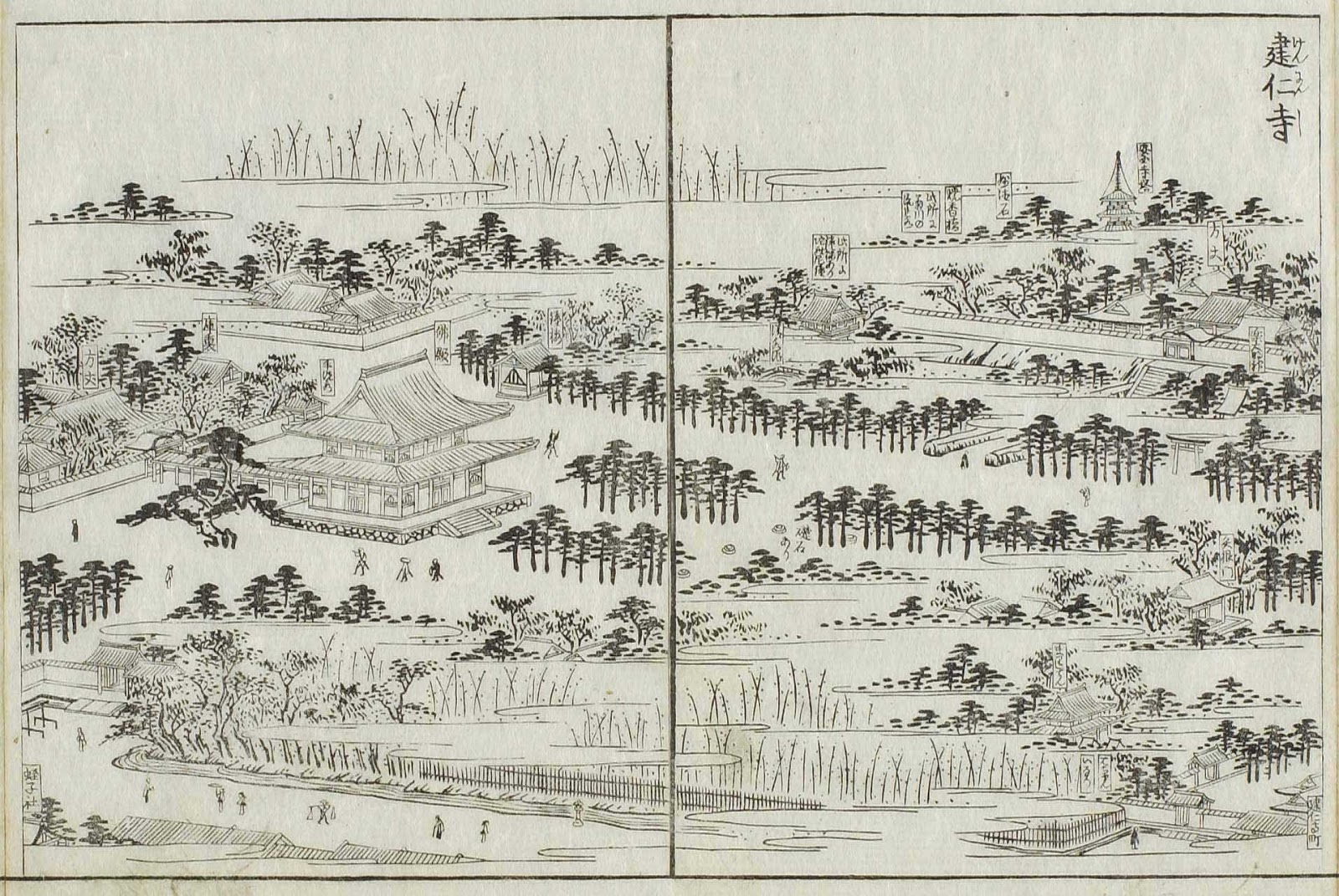
Kennin-ji (建仁寺),
is a historic Zen Buddhist temple in Higashiyama, Kyoto, Japan, near Gion, at the end of Hanami Lane. It is considered to be one of the so-called Kyoto Gozan or "five most important Zen temples of Kyoto".
Kennin-ji was founded in 1202 CE and claims to be the oldest Zen temple in Kyoto.

The monk Eisai, credited with introducing Zen to Japan, served as Kennin-ji's founding abbot and is buried on the temple grounds. For its first years the temple combined Zen, Tendai, and Shingon practices, but it became a purely Zen institution under the eleventh abbot, Lanxi Daolong (蘭渓道隆 Rankei Dōryū) (1213–1278).

The Zen master Dōgen, later founder of the Japanese Sōtō sect, trained at Kennin-ji. It is one of the Rinzai sect's headquarter temples.
- MORE in the wikipedia -


. Kennin-Ji Kaisan Ki 建仁寺開山忌 .
Eisai-Ki 栄西忌 Eisai Memorial Day
- - - kigo for late summer - - -
Eisai Zenji 栄西禅師 (1141-1215), a Japanese monk, founded the Rinzai school of Zen Buddhism after studying with the T'ien-T'ai school in China. He is also with credited with bringing tea from China and thereafter initiating the Japanese Tea Ceremony.


CLICK for enlargement!
- source : Nobuo on facebook -

::::::::::::::::::::::::::::::::::::::::::::::::::::::::::::::::::::::::::::::::::::::::::::::::::::: 

[ . BACK to WORLDKIGO . TOP . ]
[ . BACK to DARUMA MUSEUM TOP . ]
- #kenninji -
:::::::::::::::::::::::::::::::::::::::::::::::::::::::::::::::::::::::::::::::::::::::::::::::::::::

1/05/2012

Chinese Dragon

[ . BACK to DARUMA Museum TOP . ]
:::::::::::::::::::::::::::::::::::::::::::::::::::::::::::::::::::::::::::::::::::::::::::::::::::::

Chinese Dragon for 2012


2012 龍年春帖,祝福台灣綠色大地上,紅光照耀,活力如龍。

Photo from 石博進
Joys of Japan

::::::::::::::::::::::::::::::::::::::::::::::::::::::::::::::::::::::::::::::::::::::::::::::::::::: 


[ . BACK to WORLDKIGO . TOP . ]
[ . BACK to DARUMA MUSEUM TOP . ]
:::::::::::::::::::::::::::::::::::::::::::::::::::::::::::::::::::::::::::::::::::::::::::::::::::::

1/04/2012

Tawara Tota - Legend

[ . BACK to DARUMA Museum TOP . ]
:::::::::::::::::::::::::::::::::::::::::::::::::::::::::::::::::::::::::::::::::::::::::::::::::::::

Tawara Toota Hidesato 俵藤太秀郷 Tawara Tota
Fujiwara no Hidesato 藤原秀郷


source : oomukade.fc2web.com

Tawara Tota Emaki 俵藤太絵巻 scroll
Click this link for the three scrolls:
source : osaka-ohtani.ac.jp


:::::::::::::::::::::::::::::::::::::::::::::::::::::::::::::::::::::::::::::::::::::::::::::::::::::


Tawara Tōda, "Lord Bag of Rice"

source : ioreth.org/mukashi/tawaratoda.html

Mukashi mukashi,
a samurai named Fujiwara Hidesato came to a bridge that spanned the beautiful Lake Biwa. He was about to cross it when he noticed a great serpent fast asleep, in the middle of the bridge. Hidesato, without a moment's hesitation, climbed over the dragon and went on his way.

He had not gone far when he heard someone calling to him. He looked back and saw that the dragon was gone. In its place, a man stood bowing to him courteously. He was a strange looking man with a dragon-shaped crown resting on his red hair.

"I am the Dragon King of Lake Biwa,"
explained the red-haired man. "A moment ago I took the form of a dragon in the hope of finding a mortal who would not be afraid of me. You, my lord, showed no fear, and I rejoiced exceedingly."

"A great centipede lives in the woods on the mountain. Every day he comes down to the shore to drink. He dips his thousand poisonous feet into the beautiful water, turning it all foul and dirty. He enters my palace, and destroys my children and grandchildren. One by one they have been eaten by this creature, and I fear that unless something can be done that I too will be eaten. I have waited a long time for a brave man. All who have seen me so far as a dragon have run away. You are brave, so I beg that you will kill my enemy."

Hidesato thought and said,
"I do not know if I can help you, but I will gladly go with you and try."

When Hidesato reached the Dragon King's palace he found it to be a magnificent building, hardly less beautiful than the Dragon Palace of the Sea. It was a beautiful house, all made of coral and pearl. His servants, the crabs and sunfishes, brought them rice, fruit, and tea, served on tiny green leaves. The tea looked like water and the rice looked like seafoam, but they tasted all right.

While he feasted ten goldfish danced, and just behind them ten carp played skillfully on the koto and shamisen. Hidesato was thinking how excellent the entertainment was, when they heard an awful roaring and rumbling. It sounded as though a mountain were being torn up.

Hidesato and the Dragon King hastily rose and ran to the balcony. They saw that Mount Mikami was scarcely recognizable, for it was covered from top fo bottom with the great coils of the centipede. In its head glowed two fiery lights, and its hundred feet were like a long winding chain of lanterns.

Hidesato fitted an arrow to his bowstring and pulled it back with all his might. The arrow sped forth into the night and struck the centipede in the middle of the head, but glanced off immediately without inflicting any wound. Again Hidesato sent an arrow at the monster, where it struck and fell harmlessly to the ground. He had only one arrow left, and the monster was almost at the water's edge.

Suddenly he remembered that when he was a boy his grandfather had told him that if you wet the head of an arrow in your mouth it will kill any monster.

It took just a second to wet the head of his last precious arrow and send it whizzing at the centipede. It struck him on the forehead and he fell over dead. Lake Biwa, with its palace beneath, was shrouded in darkness. Thunder rolled, lightning flashed, and it seemed for the moment that the Dragon King's palace would fall to the ground.

The next day, however, all signs of the storm had vanished. The sky was clear and the sun shone brightly. In the sparkling blue lake lay the body of the centipede.

The Dragon King and his family and servants were overjoyed. Hidesato was feasted again, and when he departed a retinue of fish turned into men escorted him. The Dragon King gave Hidesato five gifts: two bells, a bag of rice, a roll of silk, and a cooking pot. The Dragon King accompanied him as far as the bridge.

When he reached his home, he found he had been given no ordinary gifts. The roll of silk would never empty no matter how much of it he used, the cooking pot would cook without need of any fire, and best of all, the rice bag was inexhaustible. Only the bells were ordinary, and these he presented to a nearby temple. He grew rich and became famous. People no longer called him Hidesato, but Tawara Tōda, or "Lord Bag of Rice".


-- Combined from two English versions,
translated by F. Hadland Davis and Teresa Williston.
source : ioreth.org/mukashi/tawaratoda.html

.................................................................................


Fujiwara no Hidesato was a real historical warrior, most famous for his famous defeat of the rebel warrior Taira Masakado (for more information on this episode, see Karl Friday's The First Samurai). Interestingly, Masakado was also said to have been slain by an arrow. This story is said to have taken place before his battle with him. The Tōda part of his name actually means "firstborn son of the Fujiwara", and the Tawara part, rather than meaning "straw sack" as the folktale says, was likely taken from a town where Hidesato lived later in his life.

Insects and spiders in Japanese folklore were thought of as impure but supernatural creatures, mostly because of the way they ruined crops. Centipedes (mukade 百足) were no different.

This story, while more about the centipede than the dragon, aptly illustrates the differences between Eastern dragons (ryū or tatsu 竜) and Western ones.
In the East, dragons are creatures of air and water, living either in the heavens where they fly without wings, or in the depths of lakes or oceans. They are also creatures of order, and represent wisdom, age, strength, and supernatural power. Contrast this to the fiery, chaotic role of the dragon in Western myths and fairy tales.
In the West, dragons are always a threat to the heroes, something to be defeated and against which one can test himself; while ryū are nearly always messengers of heaven or beings of good.
There are exceptions, of course, such as Kiyohime, and a man who was reincarnated as a great serpent to take his revenge (which, while antagonistic, is far from evil).

The Dragon King (Ryūō 竜王) in this story is not the same as the Dragon King in other stories; in folklore, every body of water might have its own dragon. Ryūgū 竜宮, the Dragon Palace of the Sea, is also referenced. This palace appears in other tales such as "The Monkey's Liver" and "Urashima Tarō".

As Japanese were largely unfamiliar with red-haired people, the colour was used to indicate a stranger or a supernatural person.

::::::::::::::::::::::::::::::::::::::::::::::::::::::::::::::::::::::::::::::::::::::::::::::::::::: 


source : www.asia.si.edu

Tawara Tota Hidesato and the Dragon Princess of Seta
1865
Tsukioka Yoshitoshi

::::::::::::::::::::::::::::::::::::::::::::::::::::::::::::::::::::::::::::::::::::::::::::::::::::: 


source : www.christies.com

Ryugujo, Tawara no Tota Hidesato ni sanshu no miyage okuru
(The Dragon Palace:
Tawara no Tota Hidesato is given three gifts)

Utagawa Kuniyoshi


. . . CLICK here for Photos of the scroll !


. Bishamonten and the Mukade Centipede .

. mukade 蜈蚣 と伝説 Legends about the centipede .

Fujiwara no Hidesato - Tawara Tota Emaki 俵藤太絵巻
is shooting the centipede at the Dragon King’s Palace
print by Tsukioka Yoshitoshi
. mukade 蜈蚣 centipede .

::::::::::::::::::::::::::::::::::::::::::::::::::::::::::::::::::::::::::::::::::::::::::::::::::::: 


. Poet Tawarabo 田原坊 .

He was born in Sagawa no Kuni (Kanagawa prefecture) in the late Edo Period. In Sagami, even now there are many people with the name of TAHARA.
He choose the reading of a famous warrior of the Heian period, Tawara no Hidesato 藤原秀郷, who was also called
Tawara no Toota 俵藤太/ 田原藤太(たわらのとうた).


[ . BACK to WORLDKIGO . TOP . ]
[ . BACK to DARUMA MUSEUM TOP . ]
:::::::::::::::::::::::::::::::::::::::::::::::::::::::::::::::::::::::::::::::::::::::::::::::::::::

1/03/2012

Nobori ryu ascending

[ . BACK to DARUMA Museum TOP . ]
:::::::::::::::::::::::::::::::::::::::::::::::::::::::::::::::::::::::::::::::::::::::::::::::::::::

Nobori ryuu 昇り竜 / 登り竜 ascending dragon
昇龍・登龍
climbing dragon, flying dragon, noboriryuu

and tako kites with dragons

This dragon is used for many decorations and paintings.


Here is even one with Daruma
This is a signature on a kite


source : www.townnews.co.jp
招福凧の凧っ平 made by Asami san 浅見宝


:::::::::::::::::::::::::::::::::::::::::::::::::::::::::::::::::::::::::::::::::::::::::::::::::::::


source : ibaraki-hanawa.com


:::::::::::::::::::::::::::::::::::::::::::::::::::::::::::::::::::::::::::::::::::::::::::::::::::::


. Yookaichidako 八日市凧 Giant Tako Kite from Yokaichi . - Shiga


:::::::::::::::::::::::::::::::::::::::::::::::::::::::::::::::::::::::::::::::::::::::::::::::::::::


. Kai no fukuryuu 甲斐の福龍 Lucky Dragon from Kai province .

When the plain of Kofu was still a lake, a dragon lived there. The Gods asked the dragon to make a sacrifice for the people, dry out the lake and give them land to farm in its place.
The dragon agreed to this proposition. In a great whirlwind he swept the water of the lake toward the sky and the plain was born.
The toy shows this "ascending dragon", which is now an amulet for good luck.


:::::::::::::::::::::::::::::::::::::::::::::::::::::::::::::::::::::::::::::::::::::::::::::::::::::


A plant called Nobori Ryu
Climbing Dragon Sacred Lily

Rohdea japonica


source : www.plantdelights.com


::::::::::::::::::::::::::::::::::::::::::::::::::::::::::::::::::::::::::::::::::::::::::::::::::::: 


Kaidan Nobori Ryu - The Blind Woman's Curse
directed by Teruo Ishii and starring Meiko Kaji
. . . CLICK here for Photos !


:::::::::::::::::::::::::::::::::::::::::::::::::::::::::::::::::::::::::::::::::::::::::::::::::::::


. . . CLICK here for Photos !


::::::::::::::::::::::::::::::::::::::::::::::::::::::::::::::::::::::::::::::::::::::::::::::::::::: 

[ . BACK to WORLDKIGO . TOP . ]
[ . BACK to DARUMA MUSEUM TOP . ]

:::::::::::::::::::::::::::::::::::::::::::::::::::::::::::::::::::::::::::::::::::::::::::::::::::::

1/02/2012

- Dragon Words - Vocabulary

[ . BACK to DARUMA MUSEUM TOP . ]
::::::::::::::::::::::::::::::::::::::::::::::::::::::::::::::::::::::::::::::::::::::::::::::::::::: 

Dragon Words


Copy any of the Chinese characters below and google here
. google images japan .


doragon ドラゴン dragon, Drachen


ryuu, ryoo, tatsu 竜; 龍 dragon


fukuryuu 伏龍; 伏竜 "lying dragon", suicide divers (in WW II)
... fukuryuu hoosuu 伏竜鳳雛 gifted young person
liegender Drache


garyuu 牙龍; 牙竜 dragon's fang.
Drachenzahn

garyuu 臥龍; 臥竜 "dragon lying down" reclining dragon
great man; exceptional person hidden among the masses;
liegender Drache. in der Welt unbekannte große Persönlichkeit
... garyuu hoosuu 臥竜鳳雛 gifted young person
... garyuu tensei 画龍点睛; 画竜点睛; 画竜天睛; 臥龍点睛
the finishing touch, critical step

ginryoosoo ギンリョウソウ (銀竜草) Ginryō-sō, Indian pipe
Monotropa uniflora, Monotropastrum globosum

gyoryuu 魚竜 "fish dragon" ichthyosaur. Ichthyosaurus


haooryuu 覇王竜 tyrannosaurus rex

hakuryoo, hakuryuu 白竜 white dragon
weisser Drache

hiryuu 飛竜 flying dragon
fliegender Drache
hiryuuzu, hiryoozu 飛竜頭; 飛竜子 filhos.
food, prepared from rice four.


Iseebi, ise-ebi いせえび 竜蝦 / 伊勢海老 'spiny lobster'
Hummerkrabbe, Hummer,Languste, Garnele


jiryuu 地竜 "land dragon"
herbal medicine prepared from dried earthworms
chinesische Medizin


karyoo 火竜 firedrake
... karyoosen 火龍船
... karyoohoo 火龍炮
... karyuu 火龍 a figure in the shogi game
Feuerdrache

keiryuu kihei 軽竜騏兵 Royal light cavalry
leichte Kaiserliche Kavallerie

konryoo 袞竜; 袞龍 imperial robes. Kleidung des Kaisers

kooryuu 亢竜 dragon which has already ascended to heaven
in den Himmel aufgestiegener Drache

kooryuu, kooryoo 蛟竜; 蛟龍 rain dragon, hidden genius
Wasserdrache, Regendrache.
Person mit versteckten großen Fähigkeiten.

kyooryuu 恐竜 "terrible dragon", dinosaur
Dinosaurier

(other dinosaur words will not be added)


mogura モグラ; モグラモチ (土竜; 土龍) "earth dragon", mole
Mogera imaizumii. Maulwurf


noboriryuu, nobori ryuu 昇り竜/登り竜 ascending dragon, rising dragon
aufsteigender Drache


ooryuu 応竜; 応龍 Yinglong, Chinese dragon with wings
Chinesischer Drache mit Flügeln


peeron 飛竜; 白竜 "flying dragon, white dragon", peron dragon boat
Drachenboot


reiroo 玲瓏 transparent, with no cloud in the sky
- roo 瓏 clarity, sound of jewels

.........................................
RYU ........................................

ryuubanrui 竜盤類 Saurischia dinosaurus
Echsenbeckensaurier

ryuuga 竜駕 imperial carriage
kaiserliche Kutsche

ryuugan 竜眼 "dragon eye" longan plant
Dimocarpus longan, Euphoria longana. Longanbaum; Drachenauge

ryuugan 竜顔 "dragon face" imperial countenance
Gesicht des Kaisers

ryuuguu 竜宮 dragon palace. Drachenpalast
ryuuguujoo 竜宮城 palace of the Dragon king
Schloss des Drachenkönigs am Meeresgrund

ryuuhimaki, ryuuhi maki 竜皮巻 vinegared white fish rolled with konbu
Fischrolle mit Kombu

ryuujin 龍神; 竜神 dragon god, dragon deity
Drachengott
ryuujoo kohaku 竜攘虎搏 (りゅうじょうこはく) fierce fight
heftiger Kampf (wie zwischen Drachen und Tiger)

ryuukihei 竜騎兵 "dragon cavalry", dragoon
Dragoner-Regiment

ryuuko 竜虎; 龍虎 "dragon and tiger", two mighty rivals, hero, good writer
Drache und Tieger. Zwei Helden
... ryuuko aiutsu 竜虎相搏つ diamonds cut diamonds
... ryuuko no arasoi 竜虎の争い well-matched contest

ryuukotsu 竜骨 "dragon bone", keel. Kiel
... ryuukotsuza 竜骨座 keel star, carina constellation
Carina (Sternbild des südlichen Himmels

ryuukyakurui 竜脚類 sauropod. Sauropoden

ryuume 竜馬 "dragon horse", - splendid horse
- promoted bishop in the boardgame shogi
"Drachen-Pferd", prachtvolles Pferd. Shōgi-Spielfigur.

ryuunoo 竜脳 borneol, crystalline turpenoid alcohol
Borneokampfer
..... ryuunoogiku 竜脳菊 Chrysanthemum makinoi Matsum


.................................................................................

ryuu no hige 竜の髭 . 龍の髭
"beard of a dragon"

dwarf mondo grass
..... janohige no hana, ja no hige no hana 蛇の髭の花
flower of the snake beard plant
Ophiopogon japonicus


plant kigo for early summer

In autumn it has beautiful blue pearls.

.................................................................................


ryuu o 竜王 dragon king. Drachenkönig
Naga-Raja

ryuusen 竜船 "dragon boat". Drachenboot

ryuusha 竜舎 Ryusha, part of a pagoda finial
kugelförmige Verziehrung des metallenen Aufsatzes einer Pagode

ryuusha 竜車 "dragon carriage", imperial carriage
kaiserliche Kutsche

ryuushuu 竜舟; 龍舟 dragon boat. Drachenboot
(usually canoe for 22 persons for traditional boat racing)

ryuutan, rindoo 竜胆 gentian, bellflower, Gentiana scabra. Enzian
... tsururindoo 蔓竜胆 Tripterospermum japonicum
... harurindoo, haru rindoo 春竜胆 Gentiana thunbergii

ryuuteki 竜笛; 龍笛 "dragon flute" from bamboo
Drachenflöte

ryuuten sazae 竜天栄螺 tapestry turban shell, Turbo petholatus
"Drachen-Kreiselschnecke"

ryuutoo 竜灯 "dragon lamp"
phosphorescent lights seen at sea at night, thought to be the torches of the Dragon King
Meeresleuchten

ryuutoo tabi 竜頭蛇尾 "head of dragon, tail of snake"
strong beginning and a weak ending
Antiklimax. starker Anfang und schwaches Ende

ryuuza 竜座 "dragon seat" Draco constellation
Draco Sternbild des nördlichen Himmels

ryuuzenkoo 竜涎香 ambergis incense
Amber. Ambra -Duftstoff aus der fettigen Darmausscheidung des Pottwals


ryuuzetsuran リュウゼツラン 竜舌蘭; 龍舌蘭 American agave; century plant
lit. tongue of a dragon
(Agave americana)
plant kigo for all summer


ryuuzu 竜頭 "dragon head" - part of a temple bell
Ring am oberen Teil einer Tempelglocke
- tatsugashira part of armour
竜頭の滝
竜頭山神社
竜頭泉
ryuutoo gekishu 竜頭鷁首 two boats, one with dragon head, one with heron head
used in the Heian period
ryuzumaki no tokei竜頭巻きの時計 arm watch,
Aufzieh-Armbanduhr


............................................ S .....................................


seiryoo, seiryuu 青龍; 青竜 "blue dragon", "green dragon"
Azure Dragon God in the East
der Azurblaue Drache
..... seiryuutoo青竜刀 chinese broad sword
chinesisches Breitschwert

shako シャコ /蝦蛄; 青竜蝦 mantis shripm
Heuschreckenkrebs. Oratosquilla oratoria

shooryuu 昇竜 rising dragon
aufsteigender Drache

shugoryuu 守護竜; 守護龍 guardian dragon
guards the "dragon cave" 龍穴
Schutz-Drache

sooryoo, sooryuu 蒼竜; 蒼龍 blue dragon
Azure Dragon God


Tatsutahime 竜田姫 princess Tatsutahime; goddess of autumn
Herbstgöttin

tatsutaage, tatsuta age 竜田揚げ; 立田揚げ; 竜田揚;
立田揚 food. flavored fish meat, deep fried

tatsu no kuchi 竜の口 dragon-head gargoyle, gutter sprout
Drachenmaul. Wasserspeier
(very seldom ryuu no kuchi)

tatsu no otoshigo 竜の落し子 sea horse
"lost child of the dragon"
Seepferdchen . fam. Hippocampinae

tatsumaki 竜巻き "winding dragon" tornado
Trombe, Wasserhose, Windhose

tenryuu hachibushuu 天竜八部衆; 天龍八部衆 "heavenly dragons"
the eight legions (devas, nagas, yakshas, gandharvas, ashuras, garudas, kimnaras, mahoragas)

tokage 蜥蜴; 石竜子 "stone dragon child" lizzard
Eidechse. Eumeces latiscutatus
..... tokageza 蜥蜴座 Lacerta constellation
Lacerta Sternbild am nördlichen Himmel

tooryuumon 登竜門; 登龍門 "dragon gate" gateway to success
Tor zum Erfolg


uuron 烏龍; 烏竜; 鳥龍 / ウーロン Oolong
ウーロン茶, 烏竜茶 Oolong Tea


:::::::::::::::::::::::::::::::::::::::::::::::::::::::::::::::::::::::::::::::::::::::::::::::::::::


tatsu, shin 辰 dragon, fifth Chinese zodiac animal
in combination with others in the sexagenary cycle

boshin 戊辰 Boshin. fifth of the sexagenary cycle


hinoe tatsu 丙辰 53rd of the sexagenary cycle

hokushin 北辰 North Star, pole star, Polarstern
Hokushin gongen 北辰権現
北辰一刀流


jishingi 時辰儀 chronometer

jitsugetsu seishin 日月星辰 sun, moon and stars
Sonne, Mond und Himmelskörper


kanoe tatsu, kooshin 庚辰 17th of the sexagenary cycle
kanoe tatsu, kooshin 甲辰 41st of the sexagenary cycle

kashin 嘉辰; 佳辰 auspicious day or occasion
glückverheißender Tag


mizunoe tatsu 壬辰 29th of the sexagenary cycle


seishin 星辰 stars, celestial bodies. Himmelskörper
seishin suuhai 星辰崇拝
Astrolatrie, Sternverehrung

shinsha 辰砂; 辰沙 cinnabar, cinnabar lacquerware
Zinnober


tanshin 誕辰 "birthday dragon"
Geburtstag

tatsumi 辰巳; 巽 "dragon and snake" southeast,
Südosten
辰巳上
辰巳之園
辰巳用水
辰巳_(江東区)
辰巳の森海浜公園
tatsu no koku 辰の刻 "hour of the dragon" 8 am

tatsumi geisha 辰巳芸者 geisha from Fukagawa, a red-light district in Edo

tatsudoshi 辰年 year of the dragon. Drachenjahr
tatsu no toshi 辰の年 year of the dragon
Jahr des Drachen


Tatsumi Geisha by Utagawa Toyokuni 歌川豊国

:::::::::::::::::::::::::::::::::::::::::::::::::::::::::::::::::::::::::::::::::::::::::::::::::::::


Many items have already been covered in the Daruma Museum.

. SEARCH the Daruma Museum .


. Chinese characters for Dragon - Kanji .


. Dragon Quotes .

[ . BACK to DARUMA MUSEUM TOP . ]
:::::::::::::::::::::::::::::::::::::::::::::::::::::::::::::::::::::::::::::::::::::::::::::::::::::

1/01/2012

Temple Ryuko-Ji

[ . BACK to DARUMA Museum TOP . ]
:::::::::::::::::::::::::::::::::::::::::::::::::::::::::::::::::::::::::::::::::::::::::::::::::::::

Ryuukooji 龍口寺 Ryuko-Ji


source : Peter Miller, kamprint.com

::::::::::::::::::::::::::::::::::::::::::::::::::::::::::::::::::::::::::::::::::::::::::::::::::::: 


Ryukoji Temple 龍口寺
Tatsu no Kuchi  竜の口 藤沢

quote
Ryukoji stands on the site of the former Tatsu no Kuchi Execution Grounds, and its names uses the same two kanji. It was here that Nichiren was to have been executed in 1271. Nichiren was the only man who survived from the execution at this ground. After this event, Nichiren was banished to Sado Island for three years. Nichiren wrote many books and scrolls with the experience of Tatsukuchi.

In 1337, Nichiren's student, Priest Nippo, established Temple here in Tatsunokuchi.

Major buildings at the temple include the Hondo, a five-story pagoda, a stupa, and the Shichimendo. The cave were Nichiren was confined is preserved on the grounds.
A statue of him stands in the courtyard in front of the Hondo.

Main Temple
built in 1832. One of the popular Kanagawa style building.

Five-story Pagoda
built in 1910. Kanagawa's only five-story pagoda.

Sanmon Gate
built in 1864.

Myokendo 妙見堂
built in 1720.

source : www.mustlovejapan.com


. Saint Nichiren 日蓮 .


. Temple Honryu-Ji in Kamakura .
神奈川県鎌倉市腰越2-26-2 - 龍口山

::::::::::::::::::::::::::::::::::::::::::::::::::::::::::::::::::::::::::::::::::::::::::::::::::::: 


. . . CLICK here for Photos !


:::::::::::::::::::::::::::::::::::::::::::::::::::::::::::::::::::::::::::::::::::::::::::::::::::::

quote
Jakkozan Ryukoji Temple
3-13-37 Katase, Fujisawa, Kanagawa

The Temple's beginning (Engi)

June, 1271, Kamakura was suffering from a great drought. Nichiren Shonin prayed for rain as did the priest Ryokan-bo Ninsho of the Gokurakuji Temple. Although Nichiren's prayer brought rain and Ryokan's did not, Nichiren was summoned by the court on September 10. Nichiren Shonin submitted his writing, the "Rissho Ankoku-ron" to the government for a second time on September 12. In the evening on that day, he was arrested by Hei-no Yoritsuna who had attacked Nichiren's hut at Matsubagayatsu in August of 1260. At the court, Nichiren Shonin remonstrated the government, "I, Nichiren, am like a pillar of Japan. Losing me is the same as a pillar of Japan toppling down. I predict that Japan will experience domestic rebellion and foreign invasion in 100 days." As a result, the government determined to exile Nichiren Shonin to Sado Island and sent him to Honma's residence in Echi, Kanagawa. However, Yoritsuna planned secretly to execute Nichiren Shonin, so he was taken to the execution grounds at Tatsunokuchi on the night of September 12.

At the moment when Nichiren Shonin was to be beheaded, an object shining like the moon at the edge of Enoshima Island flew across the sky like a ball of lightning. The executioner and guards were frightened by the sight and Nichiren Shonin thus escaped execution.

September, 1337, Nippo enshrined the founder Nichiren Shonin's statue and founded the temple. In 1601, a great hall was built.
source : AboutUs/major/ryukoji.html


::::::::::::::::::::::::::::::::::::::::::::::::::::::::::::::::::::::::::::::::::::::::::::::::::::: 

. Temples with Dragon Names .


[ . BACK to WORLDKIGO . TOP . ]
[ . BACK to DARUMA MUSEUM TOP . ]
:::::::::::::::::::::::::::::::::::::::::::::::::::::::::::::::::::::::::::::::::::::::::::::::::::::

Painting Meiji

[ . BACK to DARUMA Museum TOP . ]
:::::::::::::::::::::::::::::::::::::::::::::::::::::::::::::::::::::::::::::::::::::::::::::::::::::

Painting from the Meiji Period


source : Robin D Gill

print from a Meiji Era book
PORTRAIT OF THE NEW YEAR
「新年画賛」

年立つもじっと立つことなき辰を
腰かけ画けし爪さきまでも  


::::::::::::::::::::::::::::::::::::::::::::::::::::::::::::::::::::::::::::::::::::::::::::::::::::: 

. Dragon and Paintings .


[ . BACK to WORLDKIGO . TOP . ]
[ . BACK to DARUMA MUSEUM TOP . ]
:::::::::::::::::::::::::::::::::::::::::::::::::::::::::::::::::::::::::::::::::::::::::::::::::::::

Fusuma sliding doors

[ . BACK to DARUMA Museum TOP . ]
:::::::::::::::::::::::::::::::::::::::::::::::::::::::::::::::::::::::::::::::::::::::::::::::::::::

Fusuma-e 襖絵 Sliding Door Painting


Photo : Pedro Teixeira da Mota

大徳寺 塔頭  龍源院 
Temple Daitoku-Ji, Ryuugenin, Ryugen-In


::::::::::::::::::::::::::::::::::::::::::::::::::::::::::::::::::::::::::::::::::::::::::::::::::::: 


source : photozou.jp


Ryooanji 龍安寺 Temple Ryoan-Ji. Kyoto
not : Ryuuanji 龍安寺 Temple Ryuan-Ji

::::::::::::::::::::::::::::::::::::::::::::::::::::::::::::::::::::::::::::::::::::::::::::::::::::: 


. . . CLICK here for Photos !


::::::::::::::::::::::::::::::::::::::::::::::::::::::::::::::::::::::::::::::::::::::::::::::::::::: 

. Fusuma 襖絵 Sliding Door .


[ . BACK to WORLDKIGO . TOP . ]
[ . BACK to DARUMA MUSEUM TOP . ]
:::::::::::::::::::::::::::::::::::::::::::::::::::::::::::::::::::::::::::::::::::::::::::::::::::::

12/31/2011

Mount Fujisan

[ . BACK to DARUMA Museum TOP . ]
:::::::::::::::::::::::::::::::::::::::::::::::::::::::::::::::::::::::::::::::::::::::::::::::::::::


source : annyuki.blog

:::::::::::::::::::::::::::::::::::::::::::::::::::::::::::::::::::::::::::::::::::::::::::::::::::::


© artelino

Gekko Ogata 1859-1920  尾形月耕
"Gekko Zuihitsu" (Gekko's Sketch). dated 1897.

A dragon, shrouded in dark rain clouds, is soaring into the sky.
Majestic Mt. Fuji is towering above the clouds.

Thanks to Hayato Tokugawa!

:::::::::::::::::::::::::::::::::::::::::::::::::::::::::::::::::::

quote
Ogata Gekkō (尾形月耕) Ogata Gekkoo
1859-1920
was a Japanese painter and woodblock print artist of the ukiyo-e genre.

Gekkō's work was originally closely based upon that of Kikuchi Yōsai; an he was inspired by Hokusai, creating a series of one hundred prints of Mount Fuji.
However, he did develop his own style, with significant stylistic elements from nihonga.

Gekkō was among the artists whose artwork informed the Japanese populace about the progress of naval and land war known today as the First Sino-Japanese War of 1894-1895.
A number of Gekko's war images were published in Seishin Bidan by Yokoyama Ryohachi.
source : wikipedia

:::::::::::::::::::::::::::::::::::::::::::::::::::::::::::::::::::::::::::::::::::::::::::::::::::::


source : edo mingu kaido
富士越えの龍


:::::::::::::::::::::::::::::::::::::::::::::::::::::::::::::::::::::::::::::::::::::::::::::::::::::


source : yamanashi-f21

Sketch by Nakamura 中村 吉伽


:::::::::::::::::::::::::::::::::::::::::::::::::::::::::::::::::::::::::::::::::::::::::::::::::::::


CLICK for more !


:::::::::::::::::::::::::::::::::::::::::::::::::::::::::::::::::::::::::::::::::::::::::::::::::::::


. Various Dragons from Hokusai 葛飾北斎 .


. Mount Fuji 富士山, Fuji-san, or Fujiyama


[ . BACK to WORLDKIGO . TOP . ]
[ . BACK to DARUMA MUSEUM TOP . ]
:::::::::::::::::::::::::::::::::::::::::::::::::::::::::::::::::::::::::::::::::::::::::::::::::::::

11/30/2011

- Paintings - Joys of Japan

[ . BACK to DARUMA Museum TOP . ]
:::::::::::::::::::::::::::::::::::::::::::::::::::::::::::::::::::::::::::::::::::::::::::::::::::::

Paintings from Friends

. Joys of Japan - facebook

:::::::::::::::::::::::::::::::::::::::::::::::::::::::::::::::::::::::::::::::::::::::::::::::::::::

Mariusz Szmerdt

. Daruma paintings .

Mariusz Szmerdt Art Studio
source : www.zazzle.co.jp

Ink Traces of the Wandering Dragon Spirit
source : www.beyond-calligraphy.com


Dragon vs tiger


::::::::::::::::::::::::::::::::::::::::::::::::::::::::::::::::::::::::::::::::::::::::::::::::::::: 


Niko Shodou

. Daruma by Niko Shodou .


龍 - Sárkány - Dragon

2012 a sárkány éve lesz.
Vázlatok az új évhez, kalligráfiákhoz, tusképekhez.

on facebook
- Year of the Dragon
Sketches for a new year, calligraphy and sumi-e


::::::::::::::::::::::::::::::::::::::::::::::::::::::::::::::::::::::::::::::::::::::::::::::::::::: 


Kris Kondo
Painting of a dragon clay bell (dorei 土鈴)


:::::::::::::::::::::::::::::::::::::::::::::::::::::::::::::::::::::::::::::::::::::::::::::::::::::


Nomura Shigeru

::::::::::::::::::::::::::::::::::::::::::::::::::::::::::::::::::::::::::::::::::::::::::::::::::::: 


Print by Hajme, Namiki b. 1947 Tokyo
- Hajime Namiki 並木一 Namiki Hajime -


Titled Tornado in respect for the ancient belief that dragons always dwelt at the bottom of deep lakes and when they rose up from the depths and took to the air to go hunting they always caused a Tornado.
Isabelle Loverro


:::::::::::::::::::::::::::::::::::::::::::::::::::::::::::::::::::::::::::::::::::::::::::::::::::::


Shared by Natsuko Horinouchi


:::::::::::::::::::::::::::::::::::::::::::::::::::::::::::::::::::::::::::::::::::::::::::::::::::::


Shared by Nomura Shigeru
Joys of Japan, February 2012


::::::::::::::::::::::::::::::::::::::::::::::::::::::::::::::::::::::::::::::::::::::::::::::::::::: 

[ . BACK to WORLDKIGO . TOP . ]
[ . BACK to DARUMA MUSEUM TOP . ]
:::::::::::::::::::::::::::::::::::::::::::::::::::::::::::::::::::::::::::::::::::::::::::::::::::::